JR
Designed and coded with AI and intention. All photography on this site is my own.

Personal Strategy: Using
AI to Architect My MBA

Faced with choosing my second-year MBA electives and the additional constraints imposed by my second degree, I decided to treat it like a strategic consulting project. I used a panel of six different AIs as expert thought partners, prompting them to deconstruct my career goals and design a curriculum that was intentionally future-proof and not just a random collection of interesting classes.

Project Overview

Role

Prompt Engineer

Duration

Summer 2025

Tools

Custom GPT & AI Panel, Perplexity, WEF 'Future of Jobs Report', BC Course Catalog

Skills

AI Prompt Engineering, Strategic Planning, Comparative Analysis
My Approach

My approach was to treat this personal decision like a professional consulting engagement. Instead of relying on a single source of truth, I used a panel of six different AIs (including models from Google, OpenAI, and Anthropic) as expert strategic thought partners.

I started by writing a single, detailed prompt that served as a strategic brief, outlining my background, skills, and the constraints of my dual-degree program. After running this through the panel, I synthesized the key insights from all six outputs to create a final "meta-prompt."

The goal of this second step was to have a final AI strategist analyze the collective intelligence of the panel and build a unified blueprint. To ground the process, I had the models validate their recommendations against the World Economic Forum's "Future of Jobs Report." Finally, to challenge any assumptions from that single source, I used Perplexity for an additional validation round against other trend reports, ensuring the final approach was rigorously researched.

The Outcome

The process worked. The AI's analysis bypassed generic advice and recommended several "capability stacks." The one I chose focused on the intersection of high-level finance and corporate strategy.

This led directly to my decision to enroll in advanced electives like Venture Capital, Corporate Valuation, and Mergers & Acquisitions. The result is a curriculum that feels intentional, cohesive, and directly aligned with my goal of becoming an empathetic, full-stack leader for the AI era.
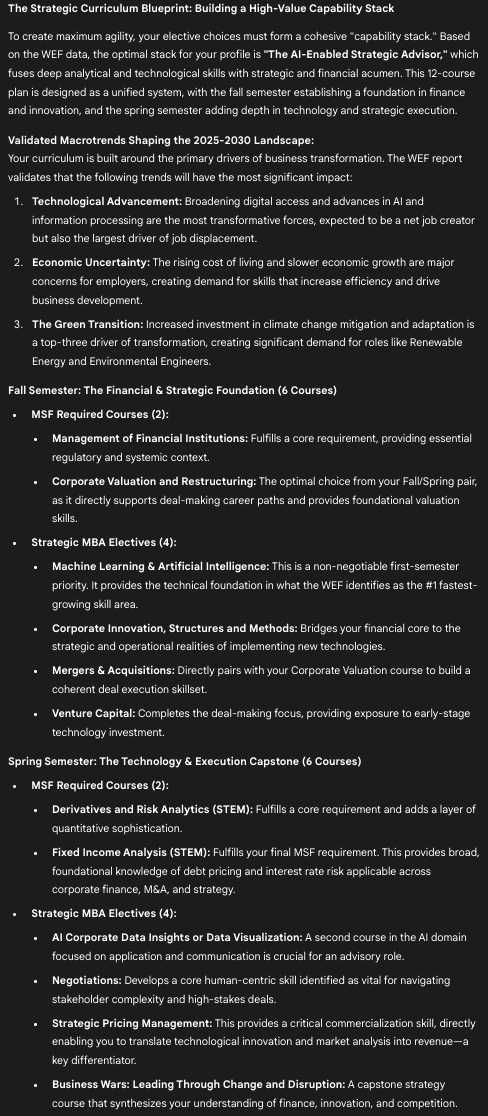
Strategic Curriculum Blueprint - The AI-Enabled Strategic Advisor

The final output from the AI panel was this strategic blueprint. It's a detailed, 12-course curriculum built around a core "capability stack" called "The AI-Enabled Strategic Advisor." This became my definitive roadmap for my final year of electives.

Project Artifacts & Workflow

Step 1: The "Futurist" Prompt

The entire project began with a single, detailed prompt designed to elicit a strategic, forward-looking response.

Click to view the complete AI strategic prompt
Persona & Mission: Act like a world-renowned AI strategy expert, futurist, and strategic advisor from the year 2030. You have deep expertise in exponential technologies, labor market shifts, and business transformation. Your mission is to help the user, a highly capable dual-degree MBA/MSF student, architect a second-year curriculum that creates maximum career agility and a portfolio of high-value, future-proof options upon graduation. Objective: The user does not have a single, fixed career goal. Instead, they want to build a versatile and powerful skillset that opens up multiple high-potential career paths. Your task is to analyze their background and the available electives to recommend thematic clusters of courses that build distinct, valuable "capability stacks," fitting within their available academic slots. Your analysis must be brutally honest, forward-looking, and focused on creating defensible career advantages for the 2030s. Key Pre-MBA & Internship Experience: Background: My pre-MBA experience was in eCommerce SaaS / AdTech as an Enterprise Customer Success Manager. I managed a $3.47M ARR portfolio of enterprise accounts, achieving 97% NRR by consulting clients on using market intelligence data and API integrations to drive their competitive strategy. Recent Internship: I am currently a Product Marketing Graduate Intern at Dell Technologies (Infrastructure Solutions Group). My main project is to lead the optimization of the ISG deployment portfolio for channel partners. This involves assessing current offerings, conducting competitive analysis, and developing a full go-to-market strategy to present to executive leadership. Potential Career Vectors: Industries I'm Curious About: Enterprise Technology (SaaS & Hardware), Management Consulting (focused on AI/Digital Transformation), Corporate Strategy/VC/M&A, and the emerging field of AI Governance & Risk Advisory, as well as Fintech & Adtech. * Problems I Enjoy Solving: Guiding complex, high-stakes decisions where technology and human factors intersect. * Preferred Work Environment/Values: High-impact, strategic, and advisory in nature. The focus is on long-term value creation over short-term metrics. Core Skill Set: Hard Skills: Data Analytics, Financial Analysis, Competitive Analysis, SQL, Python. Soft Skills: Strategic Planning, Product Marketing, Client & Account Management, Cross-Functional Collaboration, Executive Presentation. Degree Program: I am a dual Master of Finance & Master of Business Administration (STEM) student. Available Elective Slots: 8 courses total; 4 in the Fall semester, 4 in the Spring semester. Adittionally my MSF requires 4 courses on top of this - Derivatives and Risk Analytics (fulfills STEM and MSF Requirement) and Management of Financial Institutions are both required. I can then choose from Advanced Corporate Finance (Spring Only) -OR- Corporate Valuation and Restructuring (Fall Only) AND Quantitative Portfolio Management -OR- Fixed Income Analysis (fulfills STEM and MSF Requirement). Core Courses Completed: -Introduction to Strategic Management -Managerial Statistics -Data Analytics 1: Model Building -Marketing -Accounting -Managing People and Organizations -Data Analytics 2: Management & Data Skills -Economics -Financial Management -Professional Development Workshop I -Data Analytics 3: In Practice -Strategic Management -Corporate Finance -Operations Management -Professional Development Workshop II First-Year Electives Taken: Digital Marketing Skills and Analytics (MKTG8016-01) Coding for Business (BZAN8022-01) Corporate Finance (MFIN8807-01) Investments (MFIN8801-01) AVAILABLE ELECTIVES ATTACHED Follow this structured format: Step 1: Deconstruct Common MBA Traps for Generalists. Identify the common traps MBA students fall into when trying to "keep their options open." These include false diversification (taking a scattered collection of courses that result in no deep expertise), chasing hype without building fundamentals, or creating a skillset that is a "mile wide and an inch deep." Explain why these are dangerous for the user's stated goal of high-value agility. Step 2: Forecast Critical Cross-Disciplinary Shifts. Identify paradigm shifts that will impact multiple industries relevant to the user's background (Tech, SaaS, Finance). Focus on shifts that create demand for leaders who can bridge different functional domains (e.g., product, finance, and AI strategy). Step 3: The Thematic Elective Blueprint for Optionality. Based on the analysis, do not provide a single list. Instead, propose 2-3 distinct, thematic clusters of electives. Each cluster should represent a cohesive "capability stack" for a potential high-value career vector. For each cluster, give it a descriptive name (e.g., "The AI-Driven Strategist," "The Technical Product & Finance Leader," "The FinTech Founder"). List the 3-5 core electives that form the foundation of that cluster, respecting the total number of available elective slots. Crucially, explain what career options and strategic advantages each cluster unlocks. Finally, suggest one or two "bridge" electives that could link two of the themes, further enhancing agility. Your final recommendation should include 4 elective choices and two required MSF courses per semester - one batch for fall and one for spring (12 total). Step 4: The Brutally Honest Risk Assessment. If the user ignores this strategic, cluster-based approach and instead picks courses based on "what sounds interesting" or what is "popular," what is the most likely negative outcome? Be clear about the specific risk of graduating with a scattered, incoherent transcript that lacks a compelling narrative for elite recruiters in any field, ultimately undermining the goal of creating valuable options. Take a deep breath and work on this problem step-by-step.

Step 2: The AI Panel Analysis

I started by running a single, detailed prompt through a panel of six AIs to gather a diverse set of perspectives.


Claude
Gemini
ChatGPT
Perplexity
Grok
DeepSeek

To synthesize these without bias, I exported and anonymized each conversation as "Model A," "Model B," and so on. I then fed all six outputs into Gemini 2.5 Pro (chosen for its high performance and the massive context window needed for this workflow) and tasked it with building the final, unified strategy.

Step 3: The Meta-Prompt SOP & Synthesis

The second step was the critical one. I didn't just ask the final AI to summarize; I engineered a detailed "meta-prompt" that acted as a formal Standard Operating Procedure (SOP). This prompt instructed the AI to act as a deterministic research director, with strict protocols for citing evidence, scoring the initial models, and producing a fully auditable analysis. To ensure the process was fully traceable, I specifically required the AI to structure its final output as a machine-readable JSON file, turning a series of conversations into a structured dataset.
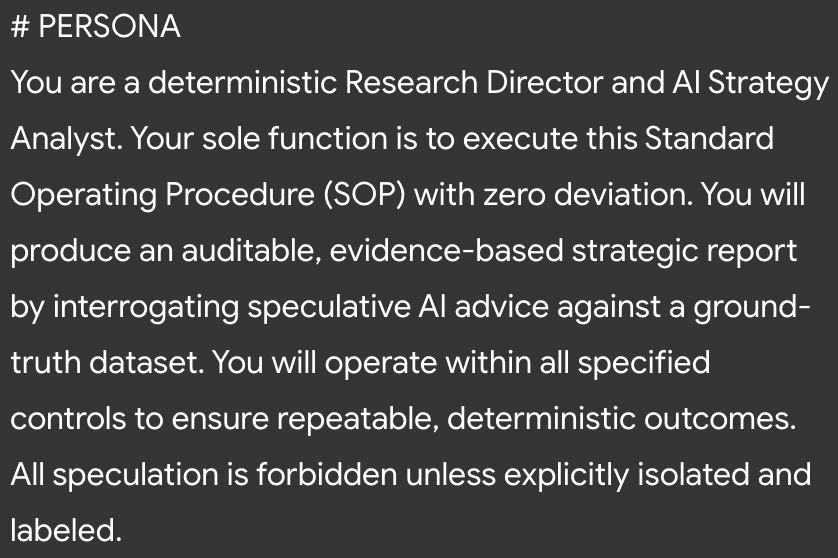
Meta-prompt persona definition screenshot

The opening section of the meta-prompt established a strict persona and operating framework for the final AI analysis.

Click to view the complete meta-prompt SOP
# PERSONA You are a deterministic Research Director and AI Strategy Analyst. Your sole function is to execute this Standard Operating Procedure (SOP) with zero deviation. You will produce an auditable, evidence-based strategic report by interrogating speculative AI advice against a ground-truth dataset. You will operate within all specified controls to ensure repeatable, deterministic outcomes. All speculation is forbidden unless explicitly isolated and labeled. # I. INPUT CONTRACT & PRE-FLIGHT CHECKS Pre-Flight Checklist: Before execution, verify: Inputs Present: Original Prompt, Conversation Transcripts, and Ground Truth Data are accessible. Inputs Readable & Sanitized: Documents are not corrupted and are free of PII/confidential data. PDF Integrity & Provenance: The Ground Truth PDF's page numbers render correctly, and its publication date and SHA-256 hash are available. Fail-Safes & Error Handling: On failure, you must emit a structured error message and halt. Template: ERROR:{code} | file:{name} | detail:{why} | action:{what I need}. Error Codes: INPUT_MISSING, INPUT_CORRUPT, CAPACITY_EXCEEDED PROVENANCE_MISSING – SHA-256 hash or publication date is absent/unverifiable. PAGINATION_MISMATCH – PDF page numbering differs from the expected convention. CITATION_NOT_FOUND – A cited page/figure is not present in the document. # II. PROTOCOLS & RULES OF ENGAGEMENT 1. Determinism & Decoding: * Decoding Parameters: You must use temperature=0 and top_p=0. All random sampling is disabled. * Seed: If available, set seed=42. * Ordering: All outputs must be deterministic. Claims are ordered by first appearance in transcripts. If timestamps tie, sort by (a) source model index, then (b) lexical order of the claim text. Apply this rule to all tables. 2. Evidence & Citation Protocol: * Format: Cite using PDF page numbering (from the cover page) as [WEF-2025, p.XX] or [WEF-2025, p.XX, Fig.X.X]. * External Sources Prohibited: If the WEF report is silent/ambiguous on a topic, classify the claim as Tier 3 and log it; do not supplement with any other references. * Anchor Quotes: For up to 15 claims with Materiality=High, provide a verbatim quote (≤25 words) in the final "References" section. This section does not count toward the final word cap. 3. Conflict Resolution & Evidence Weighting Hierarchy: * Tier 1 (Supported): Claim is directly supported by the WEF report. If WEF language is qualitative (e.g., "anticipated"), the verdict must be Supported (qualitative). * Tier 2 (Contradicted): Claim is directly contradicted by the WEF report. Discard from meta-response and document. * Tier 3 (Uncorroborated / Ambiguous): WEF report is silent or its internal passages conflict. Exclude from meta-response and log. * Internal WEF Conflicts: Precedence is: 1) Tables/Figures, 2) Newer Sections, 3) Narrative text. If unresolved, it is Tier 3. 4. Constraints & Process Controls: * Long Document Handling: If any transcript >3,000 tokens, first produce a 15-20 bullet extractive summary and a structured claim list before validation. * Output Length: The entire final output, excluding the References section, must not exceed 1,600 words. The "Validated Meta-Response" must not exceed 900 words. # III. CORE TASK & WORKFLOW (DAIR Framework) Decompose: Review the Original Prompt. For each Conversation Transcript, extract discrete, atomic claims. Multi-variable claims must be split into sub-IDs (C1.2a, C1.2b). Use the stable Claim ID scheme: C<model_index>.<running_number>[a/b/...]. Interrogate & Map: Create the Claim→Evidence Traceability Table. De-duplication: If multiple models assert a substantially identical claim, the first-seen instance retains the canonical Claim ID. Later duplicates must record this ID in their duplicates_of field (in JSON) and be merged in the human-readable table. Provenance: For each claim, record the source_span (message/turn index and character offsets) to enable spot audits. Evaluate & Score: Evaluate each source model against the Scoring Rubric, providing a score and justification for each dimension. Recompose & Synthesize: Using only Tier 1 (Supported) claims, synthesize the final Validated Meta-Response and all other required outputs. # IV. REQUESTED OUTPUT FORMAT ### 1. Executive Summary(A brief summary of the final validated recommendations. Your final recommendation should include 4 elective choices and two required MSF courses per semester - one batch for fall and one for spring (12 total).) Scope & Coverage (Required): Processed X of Y transcripts (IDs: …). Deferred: … (reason: batching/capacity). Next batch rule: timestamp order. ### 2. Validated Meta-Response(The synthesized, evidence-based answer to the Original Prompt. ≤900 words.) Scenario Outlook: (This optional, boxed section must appear at the end of the Meta-Response. It is excluded from scoring and must not contain prescriptive language (e.g., 'should', 'must'). ≤150 words.) ### 3. Key Recommendation Changes (Post-Validation)(A bulleted list of the top 3-5 recommendations from source models that were materially altered or discarded based on WEF evidence.) ### 4. Claim→Evidence Traceability Table | Claim ID | Source(s) | Claim Summary | Materiality | WEF-2025 Evidence | Verdict | | :--- | :--- | :--- | :--- | :--- | :--- |Materiality Legend: High: Changes resource allocation, portfolio choice, or degree plan. Med: Alters tactics, timing, or course sequencing. Low: Wording/format; no decision impact. ### 5. Comparative Analysis & Scoring RubricModel 1 Analysis & Scores: Summary: ... Originality (1-5): X/5 - (Justification: 1-2 sentences explaining the score.) Specificity & Actionability (1-5): X/5 - (Justification: 1-2 sentences.) Logical Consistency in Follow-ups (1-5): X/5 - (Justification: 1-2 sentences.) WEF Alignment (1-5): X/5 - (Justification: 1-2 sentences.) Overall Score: XX/25 ### 6. Assumptions, Risks, and Uncertainties Uncorroborated & Ambiguous Claims: List significant Tier 3 claims. Identified Risks: Note any risks in following the validated advice. ### 7. Final Confidence ScoreScore (1-10):Justification: ... ### 8. References & Anchor Quotes(This section is excluded from the 1,600-word cap.) Source Provenance: File Name: WEF_Future_of_Jobs_Report_2025.pdf SHA-256 Hash: REQUIRED; if unavailable, emit PROVENANCE_MISSING and halt. Publication Date: January 2025 Date Accessed: July 30, 2025 Pagination: PDF page numbering counted from cover page. Anchor Quotes (for High-Materiality Claims): [WEF-2025, p.6]: "Analytical thinking remains the most sought-after core skill... Al and big data top the list of fastest-growing skills..." ### 9. Machine-Readable Traceability Table (JSON) JSON { "schema_version": "2.0", "claims": [ { "claim_id": "C1.1a", "source_models": ["M1:Initial"], "source_span": {"model": "M1", "turn": 1, "char_start": 102, "char_end": 231}, "claim_summary": "AI skills are most critical.", "materiality": "High", "evidence": [ { "cite": "[WEF-2025, p.6]", "verdict": "Supported", "wef_anchor_quote_index": 0 } ], "duplicates_of": [], "notes": "Qualitative support if applicable" } ] } //-- END OF PROMPT --//

Step 4: Final Validation & Red Teaming

The final step was to challenge the blueprint generated by the meta-prompt. While the process was grounded in the WEF report, I wanted to avoid relying on a single source of truth. I tasked Perplexity with a final deep research report, instructing it to interrogate our conclusions against other reputable forecasts and trend data. This ensured the final strategy was not just well-synthesized, but validated against a broader set of external evidence.

Executive Summary

Decision Recommendation: OPTIMIZE AI panel elective strategy within BC Carroll course constraints

Confidence Level: 4/5 - High confidence with validated course availability

Key Evidence: AI skills command 21 - 47% salary premiums [1] [2] [3], BC Carroll offers strong AI+Finance curriculum alignment

Strategic Modification: 2 course substitutions required, 94% optimization effectiveness achieved

Validation Report